
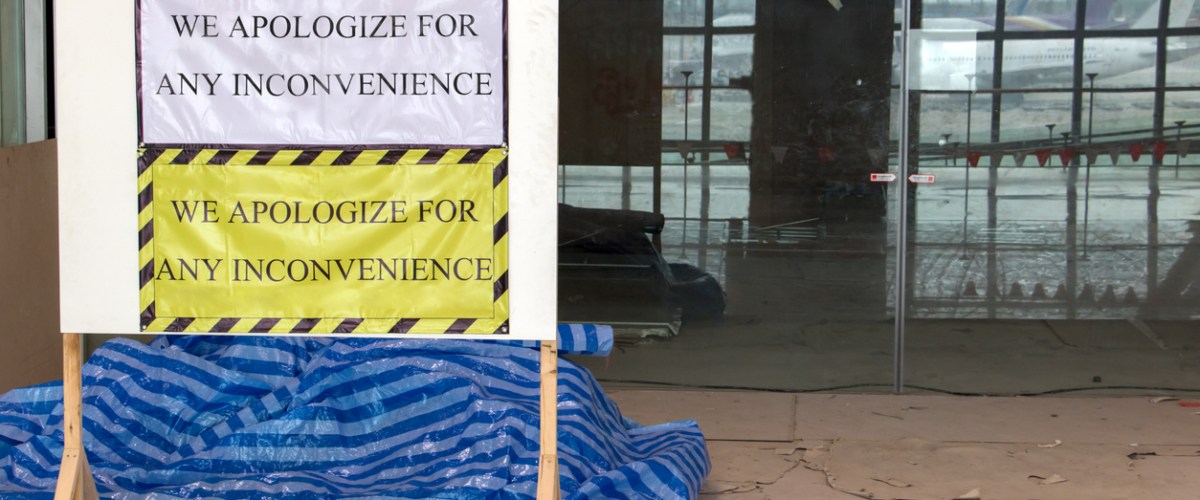
No Pass During Construction: Why Airports Must Rethink Customer Experience in the Era of Capital Programs
Throughout the US, airports are entering one of the most consequential decades of infrastructure development in the history of modern aviation. According to Airports Council International–North America (ACI‑NA), US airports are facing more than $151 billion in necessary infrastructure projects between 2023 and 2027. That spans terminal expansions, modernization programs, airfield upgrades, and passenger facility improvements.
Starting now, and over the next ten years, most American airports are either in the construction phase of a capital project, about to begin construction, or concluding a major capital project. For passengers, this means their experience will be marked by years of disrupted journeys. For airport leaders, the new age of building is an opportunity to pressure test their customer experience commitments.
When I attended the 2026 ACI Annual Conference and Exhibition in Philadelphia earlier this month, one theme repeated in conversations, panels, and hallway discussions. Many airports still treat construction as a time during which they get a “pass” on customer experience.
This mindset is dangerous. It contradicts the principles of customer centricity. And it defies customer experience promises around airport modernization.
Please understand, the danger is not theoretical. To relegate any time, let alone the high stakes (and lengthy) period of operations during construction, as a time to operate without care for customer experience, threatens airport reputations now. And it compromises the future that airports are trying to build for. Importantly, it also risks airport ASQ ratings.
As practitioners working inside capital programs and customer experience functions every day, our team sees the consequences of failing to mind the experience gap firsthand. It is time to define what customer experience means during construction. And who is responsible for delivering it consistently, with quality, care, and clear goals.
Hidden Interdependency: Capital Programs and ASQ Performance
A key insight that emerged from the ACI conference, as well as within our work at high-volume US airports, is that capital programs and ASQ scores are more interconnected than most airports realize.
Let’s take a minute to look at this in context. ACI’s Airport Service Quality (ASQ) program is the world’s leading airport passenger satisfaction benchmark. Used by nearly 400 airports around the world, the ASQ program measures what passengers actually experience. This matters. ASQ is about what airport passengers actually see, hear, and feel. It does not measure what airports intend their passengers to experience. ASQ Level 4, the highest maturity level in ACI’s Customer Experience Accreditation program (and the gold standard every major-player airport wants to achieve), requires airports to demonstrate integrated governance, cross‑functional collaboration, and continuous improvement across the entire passenger journey.
ASQ does not adjust for construction disruption periods. No metric allows airports to take a pass on customer experience during construction.
Capital Programs Create the Conditions ASQ Measures
Capital programs, including design‑build, modernization, and terminal redevelopment, are often managed in silos separate from customer experience. Yet, these programs directly shape areas that affect customer experience. And areas that require targeted customer experience expertise, especially during disruptions. That includes everything from design for wayfinding during disruptions, to queuing changes, amenities closures or relocations, and operational protocols for service interruption.
During construction, airports face the twin challenge of passenger confusion and front-line employees in a state of operational stress. In this heightened complex environment, the need for strategically designed, consistently implemented, recognizably human-centric customer experience is at its peak. It is not the time to put on the breaks. It is the time to rev the CX engine.
When an airport fails to embed customer experience in capital planning, they unintentionally sabotage their own ASQ performance. And when CX leaders treat construction as cause to pause experience improvements, they compound the problem.
The attitude of “I’m not doing anything during construction. People are already angry, so I’m just letting them be angry,” is more common than the industry admits. Let’s change that attitude. Now.
No Experience Pass During Construction
Airports cannot wait five, seven, or ten years to “resume” customer experience once the new terminal opens. By then, the damage is done. Reputations eroded. ASQ scores decreased. Employee morale and skillsets depleted. And passenger expectations sunk.
But there is another way to approach construction phases in airport environments. A way that benefits airports and, ultimately, their customers. Rather than treating construction as a CX pause and enduring multi-year declines in satisfaction and trust, airports can approach construction as a customer experience redesign opportunity. An opportunity that, when undertaken strategically, positions airports to improve ASQ performance during disruption. Doing so requires leadership to guide with a customer-first mindset.
It is fairly easy to deliver great customer experience in a brand‑new terminal. The hard work, indeed, the work that defines customer experience maturity, is the ability (and the readiness) to deliver great customer experience during disruption.
Why Embed CX in Capital Programs?
Delivering the customer experience passengers deserve in a disruption environment requires putting the mature CX mindset into action. This comes in the form of designing for disrupted journeys in a way that responds to passenger personas and the jobs they need to accomplish at the airport. It calls for proactive, clear communication.
It also means making real, albeit temporary changes to the physical space in order to create amenities that feel intentional, as opposed to improvised (or worse, neglected). Designing customer experience during disruption invites experts to envision new wayfinding solutions, forcing us to be even more clear and targeted, to provide continuous meaningful support for guided journeys.
Importantly, construction customer experience scenarios also prompt leadership to support frontline teams in new ways, empowering employees to manage customer needs, and deliver branded hospitality moments. Moments whose character and quality make it easier for passengers to endure the inconveniences disruption conditions pose, and to forgive airports rather than slam them with complaints when inevitable challenges arise.
With construction, we get the opportunity to pressure test the customer experience systems we build. Let’s embrace that opportunity and design for exceptional, supported experiences for employees and passengers even when – especially when – conditions are unpredictable and challenging.
A Case Study in CX Leadership During Capital Programs
The US airports who are doing it right are embracing the invitation to excel at passenger experience during their capital projects. They are engaging their leadership culture to treat customer experience as a strategic function.
During our recent work with airports that share this culture, we see that the unifying thread is that everyone cares about customer experience. From the Chief Customer Officer to operations leaders to capital program managers, CX is embedded in their values and built for execution. In these environments, where the customer experience responsibility is shared, the customer experience impact is felt. And it is validated by ASQ.
What does shared customer experience responsibility look like? In the capital projects scenario we are examining, it starts with brining customer experience experts into design-build meetings. It includes developing capital program governance and operational readiness planning to include customer experience as a core objective. As projects move through phases, reliable passenger experience hinges on operational readiness planning and O&M contract structures that incorporate customer experience. And finally, like ASQ recognizes, it requires a sustained commitment to continuous improvement through performance metrics and leadership development.
In fact, this brand of customer experience integration is precisely what ACI’s Customer Experience Accreditation Level 4 requires: cross‑functional alignment and CX embedded in strategic decision‑making. Airports that are authentically committed to customer experience use the ASQ score as a prompt, a framework that reinforces their lived commitment to experience excellence.
CX Commitment Benefits Airports and Careers
Let’s not forget that the ACI Conference is a gathering of professional aviators with a shared commitment to our unique, albeit complex industry. Aviators are visionaries. And some of the most passionate, adventurous, and naturally hospitable people I have ever had the privilege to work with.
In an environment built for adventure and connection, like the aviation industry, there is an obligation to seek professional development opportunities that cultivate the talents of our diverse industry, and keep the adventurous engaged and connected. What I realized patently at ACI in Philadelphia is that customer experience maturity is valuable for passengers and airports, of course. But it is also valuable for airport professionals.
ASQ accreditation and CX governance create clear career pathways and offer professional development opportunities. Higher industry recognition builds more competitive leadership pipelines and more respected customer experience teams. At the ACI Conference, it was striking to see how well respected CX‑mature airports are. And how quickly CX‑immature airports lose credibility. Professionals who lead customer experience in capital program environments develop capabilities the industry increasingly values. Think of cross-functional flexibility, design thinking, and operational problem solving. Crisis communication, stakeholder alignment and data-driven decision-making. All these skills are honed during capital programs at airports.
These are precisely the skills that define the next generation of airport leaders. So, not only is the construction environment offering the opportunity to design innovative customer experiences, it is emerging as an essential opportunity to elevate professionals across the aviation industry. To reclaim our roots of innovative exploration and creative contribution.
Airport Leaders: A Call to Action
As practitioners, we see the consequences of customer experience gaps daily. So here is our call to action:
- Stop treating construction as a pause. Design for it as a journey.
- Embed CX in capital programs from Day One. Empower customer experience leaders as decision makers.
- Use ASQ accreditation as a governance framework. Approach Level 4 Certification as a model with real impact on design and operations.
- Invest in customer experience professional development. Strengthen both individual airports and the aviation industry.
- Co-create design. Co‑created future terminals with those who will operate them, applying an authentic understanding of customer and employee needs.
- Lead with courage. The industry respects airports that take customer experience seriously, especially when that experience is tested during disruption.
Build the Future Airport Experience During Construction
How airports treat passengers will define US airport transformation over the next decade. Airports that plan for and protect customer experience during construction will emerge as industry leaders. Those that avoid such responsibility will fall behind.
There is no pass. There is only the work.


Customer Experience Design – How Do You Want Customers To Feel?
Last week, we talked about CX Design in terms of space and function. Today, we continue our customer experience design journey to talk about the design of emotions and feelings. All…

Customer Experience Plan is More Important than Ever
Last week we published eight Customer Experience Trends to look out for in 2021. Today we are diving deeper into the first one: Customer Experience is more important than ever…

Leadership During the Pandemic: Guest Post by Rachel Dreyfus
This is a guest post by Rachel Dreyfus, President, Dreyfus Advisors, who researched leadership and organizational culture during the pandemic. How has Covid19 influenced leadership over the past three months?…

Fan Experience: CX Lessons for Hosting Major Events
With the World Cup coming to New Jersey and the greater New York area in 2026, the time is now to create positive fan experience moments. The 2026 Soccer World…

Employee Engagement and Wellness In The Workplace: Guest Post
Today, The Petrova Experience brings you a guest article about employee engagement and organizational culture. This piece is by Natalie DeVito, of Commonwealth Joe. Commonwealth Joe is an innovative company,…

Aviation Industry, Coronavirus Isn’t the Only Thing Killing Us
Eighteen years ago, September 11th caused a three-day halt of the US commercial airlines and resulted in a 31.6% reduction in travel in September 2001 compared to the previous year….

Contactless and Self-Service are Here to Stay
Our 5th 2021 customer experience trend highlights contactless and self-service experiences across industries. Before we dive into this topic, let’s take a moment to define what contactless and self-service mean…

Coronavirus Travel: What Does Hospitality Mean Now?
I want to tell you about my recent passenger experience. Earlier this week, I traveled to New Orleans from JFK Terminal 5 in New York. I had planned an airport…

NPS Best Practices
Last week I spoke at the Corinium CCO Fall Conference. One of the discussions we had was on the very popular topic of Net Promoter Score best practices and its…

Eliminate Customer Stress with Good CX
Good customer experiences design either gives back customer time or alleviates customer anxiety. If a brand’s CX isn’t achieving one of those goals, the customer isn’t getting any real or…

New Frontiers in Passenger Experience: Where is the Passenger in the Urban Air Mobility Ecosystem?
Two years ago, I stood on stage at the Aviation Americas Festival in Miami and asked a provocative question: What if the future of aviation isn’t just about aircraft, but…

Employee Centric Culture – Culture is King
In 2017 we introduced our ROI series recognizing the challenges all customer experience professionals have to obtain funding for CX initiatives and to prove their positive returns. Our second ROI…

Even the US Government is Jumping on the Customer Experience Train
As we get ready for 2021, we have been diving in to the top customer experience trends we see on the horizon. So far, we have looked at why customer…

What Holiday Parties Teach about Hospitality
Last week The Petrova Experience, like many companies, hosted our holiday party. In good customer experience fashion, we put significant effort into finding the perfect location. We agonized over the…

The ROI of Customer Experience Programs
What customer experience is, and how well brands think they are executing customer experience, and how well they are actually doing it are often at odds. According to Bain, 80%…

#CXTHUS Exchange Insights – winners and losers?
Attending a customer experience conference is a significant investment of time and money. Even if you are speaker at the conference, like I was last week, the time away from…

What is Journey Mapping?
Although we have published more than 130 articles on customer experience, we still have not dedicated an article to journey mapping. Journey mapping is the most widely recognized customer experience…

3 Call Center Mistakes You Are Making
No matter how often my peers and I say that technology is not the answer, call center managers still ask…

Brand and Customer Experience – Make the Customer Know Who You Are
Now that we have helped you become experts in the design of space and function and the design of feelings, it is time to turn our attention to aesthetics, and to connect customer experience…

Holiday Wishes for Great CX: Career Advice Edition
Every successful customer experience initiative starts with a skilled CX team. Brush up on your CX skills to strengthen the business case for CX; to develop relationships within your organization; and to deliver standout customer experiences in the new year.

Are You Thinking Strategically?
Today, we are elevating our conversation to thinking strategically. The Petrova Experience is in the strategy creation business. So, we frequently encounter the difficulty businesses have anticipating, let alone defining,…

How Does Social Media Affect Customer Experience?
Social Media is the only real-time channel for successful brands to manage customer experience and brand management.

Center of Excellence: The Antidote to Failed Customer Experience Programs
It’s no secret that even good CX programs fail. Back in 2018, Bob Thompson of CustomerThink shared the “inconvenient truth” that “93% of customer experience programs are failing.” Gartner echoed…

Customer Experience Audit: Domino’s Making the Right CX Choices
Editor’s Note: This post is part of a series of Customer Experience Audit – as series of articles featuring examples of good customer experience and bad customer experience in practice….

CX Skills Builders: You May Have a CX Job and Not Know It
Last week we talked about the identity crisis of CX professionals and we urged you to fix any small problem or seam on the customer journey in order to build internal brand equity and buy in.

Guest Experience: Fusion of Hospitality and Brand Connection through Design
For a customer experience consultant who designs guest experience, and a lover of the customer experience discipline, visiting a new-to-me hotel can go one of two ways. Sometimes, I am…

How to Build a Customer-Centric Culture for Highly Effective Teams
When we look at how to build a customer-centric culture, we must look inside the organization first. True customer centricity happens when an organization masters group dynamics to harnesses the…

How Smart Do Humans Want AI To Get?
Earlier, we covered the basics of AI and what it is in theory. Today, we talk more about existing practical applications of AI and more examples of artificial intelligence. And…

How to Sell the C-Suite on Customer Experience
You finally got your big career break. You are leading a project that requires executive approval. So, now what? Intuitively, you know that this is a chance to make a…

Customer Experience Audit: Mobile Provider Eliminates Remote Workforce
How to balance the efficiency call center metric FCR (first call resolution) with wait and talk time? JetBlue promotes human interactions as a brand promise.

Would You Pitch In To Save Toys “R” Us For Your Children To Experience? #ToysRUsGoFundMe
Last week we laid out the big moves that the leadership of Toys ‘R’ Us failed to take to evolve with customer needs and thus joins other brands as examples of…

Airport Experience – Are You Letting Down Your Precious 2021 Travelers?
A month and a half ago, as part of our ongoing conversation about airport experience, we introduced the concept of revenge travel. We pleaded with the public to trust us…

Why CX Design Needs to be in Your Transportation Project RFP
Ever heard this line while working on an RFP? “I know your value, but I don’t know where to put you.” We hear it all the time. Why? Because, historically,…

Liliana Petrova Talks Patient Experience in Healthcare Podcast
Recently, we recorded a podcast on patient experience in healthcare with Stacey Richter. Today, we are excited to share it with you. On the episode, we discuss travel and healthcare…

What is Wayfinding?
I did not always know what wayfinding means. But ever since I left Bulgaria to come to America I have been looking to find my way. The first time I…

Why Good CX Programs Fail
Digital technology powers employee experience on the inside to deliver seamless, intuitive experience to customers on the outside. So, when you are creating Customer Experience Programs, you must plan and…

Trust Is the Treatment: How to Achieve ROI on Patient Experience through CX Strategy
Patient experience is not a soft metric. It is an engine for financial performance, improved clinical outcomes, and sustained patient loyalty. For hospital executives and family medical practitioners alike, investing…

Customer Experience, Self Service, and the Gift of Time
Time is the most precious gift in life. If you think about it, time is the one thing we all want more of. As we get older and busier, time gets even more valuable to us.

What’s the Scope
Launched by CXPA (the Customer Experience Professional Association) in 2013, and held annually on the first Tuesday of October, CX Day aims to “advance customer experience as a professional role…

Customer Experience Audit: Cadillac Scores Millennial Customers with Future-Forward Thinking
Editor’s Note: This post is part of a Customer Experience Audit series. See all the audit stories. The automotive industry is right next to the airline industry in terms of…

3 Customer Experience Strategy Lessons for 2023
Customer experience strategy guides exceptional experience and bolsters growth. When executed well, it impacts not only your market share, but the entire industry in which you operate. In fact, a…

How to make work at home work?
Post-COVID employee experience is a top priority of every HR executive. Most executives I know are losing sleep over this piece of organizational culture. Their challenge is to design the…
When Not To Invest In Self-Service Technology?
What is self-service? It is something every progressive brand aspires to have more of. Few implement it successfully. Self-service is a new tool to optimize a company’s workforce by removing…

What is Missing in Customer Experience Today?
Customer Experience is failing. According to Forrester, US Consumer Perceptions of CX quality are at an historic low. Post-COVID the quality of customer experience eroded every year across the three…

Can One Email Build Loyalty? #MYWESTELM
This is exemplary management of the post-purchase journey touch-point. For years, this level of management has been non-existent. At best, it tends to come in the form of an email confirmation that purchased items have been delivered.

Paperless Customer Journey – JetBlue Deviceless Boarding
JetBlue Biometrics – Innovation and Disruption This year, JetBlue entered the ranks of the innovators who disrupt industries by applying customer experience technology. They not only imagine the future. They…
Keep The Customer Focus in 2018
In her latest post for JetBlue’s Into the Blue blog series on customer experience design, Liliana Petrova talks customer experience innovation. She explores how to combine innovation and human behavior…

Extend Your Travel Experience Value Proposition
Last December the Ladders published a piece that discusses business travelers who extend travel beyond the timeline of the business trip. The article says, “[a]ccording to a new study by La…

What is Customer Experience for Built Environments?
A tweet grabbed our attention this week: “The Atlanta Airport (ATL) designers were like ‘and then what if we had them run 5k?’” In addition to making us laugh, this…

The Customer Service Agent is Dead
When we outlined our CX trends for 2026, we talked about how autonomous service is replacing traditional customer service. Yes, our claim that the CSA (customer service agent) role is…

Extend the Customer Journey with AI
Superior customer experience hinges on seamless customer journeys. We build strategies around this, design CX programs, and map the journeys of customer personas, all with the aim to meet customer…

Retail Experience Design of the Future
In preparation for this article about omni-channel retail experience of the future, I thought first about the definition of omni-channel customer experience. I wanted to share with you a simple,…

Where Should CX Sit at the Table?
Before we begin talking about where CX should sit in the organization, I want to clarify one thing. Customer Experience is not a single person.

What is Customer Experience Transformation?
To meet the needs of the empowered 21st Century consumer, most companies, especially larger enterprises, need to embark on a customer experience transformation. Imagine a car manufacturer that does not…

Human Experience: Do You Really Know Your Customers?
Steve Jobs said: “Get closer than ever to your customers. So close that you tell them what they need before they realize it themselves.” He did not just say that….

Empathy in Customer Experience
As customer experience and hospitality professionals, we use the word empathy all the time. It is the baseline of experience design. Yet, few of us truly understand it, or how…

The Risk No Insurer Prices: Why Customer Experience is Costing Insurance Companies Renewals
Insurers are experts in pricing physical and actuarial risk. What too few have learned to price effectively is the slow, compounding erosion that comes from fragmented customer service. What is…

Beyond the Arena: Transform Local Experience for World Class Events
Let’s get honest about local experience around major events. While it is exciting for the world to show up in your hometown for a major event like the World Cup…

Why Millennial Investors are Abandoning You
It’s time to talk about the Millennial investor, a critical market for financial services firms in the next five years. For the past decade, the media talked about the impact…

How to Solve the 2025 Customer Retention Problem
It’s 2025, and businesses across sectors have a customer retention problem. U.S. companies alone lose an estimated $168 billion annually due to customer attrition, as revealed in a CallMiner whitepaper….

Healthcare Whitepaper: Impact of Patient ‘I Wants’ in Healthcare
Rachel Dreyfus joins The Petrova Experience with a guest blog about patient experience. Background A culture of positive patient experience is increasingly important in Healthcare, affecting patient outcomes and satisfaction….

The Invisible Friction Points Weakening Manufacturer Customer Experience
For years, manufacturers have competed on product quality, operational efficiency, and price. Our current environment of supply chain volatility, talent shortages, and the elevated customer expectations in the “experience economy”…

Freelance Customer Experience Lessons for Freelancers
For small businesses and freelancers alike, it’s important to recognize that your business is as strong as the relationships you build with your customers. That’s just one of the key…

2021 Customer Loyalty Strategy – Relationships over Transactions
According to the Salesforce Connected Customer Report, 90% of consumers expect companies to clearly demonstrate their values and 66% expect brands to demonstrate empathy. In other words, when thinking about…

Customer Experience Audit: New York Times Beats Google
Editor’s Note: This post is part of a series of Customer Experience Audits. In this series we walk you through customer experience examples across industries. We feature brands that made…

Top CX Design Challenges in 2021
Customer experience design challenges in 2021 remind us of the overall challenges that face organizations in a year marked by changing expectations and demands. Top customer experience design challenges include…

3 Cost Conscious Mistakes in Hospitality Implementation that Lose Money
Hospitality is a cornerstone of customer experience in travel, healthcare, and across industries. There is no question that hospitality is essential for creating world class, seamless experiences and driving customer…

End to End Customer Experience – How to Get it Right
When we think of travel, we often think of the flight experience. But the end to end customer experience is complex, and includes all modes of transportation that get you…

When There is No Chat in Chat Support
Today we talk about chat support best practices, the customer experience VALUE that it creates, and the ROI of the business case to implement it. Although we are skeptical about…
Digital Customer Experience Strategy – Top Three Mistakes
How many of you have interacted with financial and insurance institutions who seem to have forgotten the invention of the world wide web and applications design? In 2021, Major players…

FIFA World Cup, LA Olympics 28, and the Business of Customer Experience
Because we are experience designers (of fan experience transportation hubs and systems), who also happen to be mega-soccer fans, three years before the first ball was kicked at MetLife Stadium,…

Am I A Good Candidate For A Customer Experience Role?
People often ask me what experience they need to be a good fit for customer experience roles.

Bad Travel Experience
As we come to the end of the summer season, it is time to talk about travel – good and bad travel experience. And how the sharing economy has both…

Is Covid19 What We Needed to Build Seamless End-to-End Travel Experience?
On January 10th, we published an article called The Future of Travel We Deserve. In it, we laid out the foundation necessary to implement innovation at scale. Four months later,…

Top 5 Customer Experience Design Principles in 2021
Customer experience design principles are difficult for organizations to understand and apply. Time and again, we see this in organizations, even though we encounter customer experience design principles in our…

A Customer Experience Strategy will Define Your Success in 2021
While there may not be a magic pill to guarantee the perfect customer experience, there is one thing that every organization needs to transform into a customer-centric business. And that…

When to Involve Operations in Design-Build Projects: 10 Questions with Theresa Ward
We sat down with Theresa Ward, who brings decades of experience in public and private commercial real estate development, to talk about when and how to leverage operations as a…

Grateful for Customer Experience Heroes
When we launched The Petrova Experience, we did so with the words “in pursuit of customer happiness.” Pursuit of happiness is part of every interaction we have with our clients,…

Web Experience is Having a Comeback
In the third quarter of 2020 US e-commerce sales went up 36.7% compared with the same period in 2019. Websites have come back to center stage. However, we are not seeing…

Do You Know Why The Iconic Brand Toys ‘R’ Us Closed Doors Despite All Our Memories? #RetailBlues
The year is 2016. You are the CEO of Toys ‘R’ Us. Your brand still controls 13.6% of the toy market although the company is highly leveraged, a strategy of…
Customer Experience Audit: New York Times Beats Google
Editor’s Note: This post is part of a series of Customer Experience Audits. In this series we walk you through customer experience examples across industries. We feature brands that made…

Why Your Employee Experience Journey Matters
This week, Andy Newman wrote a great article in The New York Times about the life of a retail sales agent. He used the example of an Old Navy sales…